

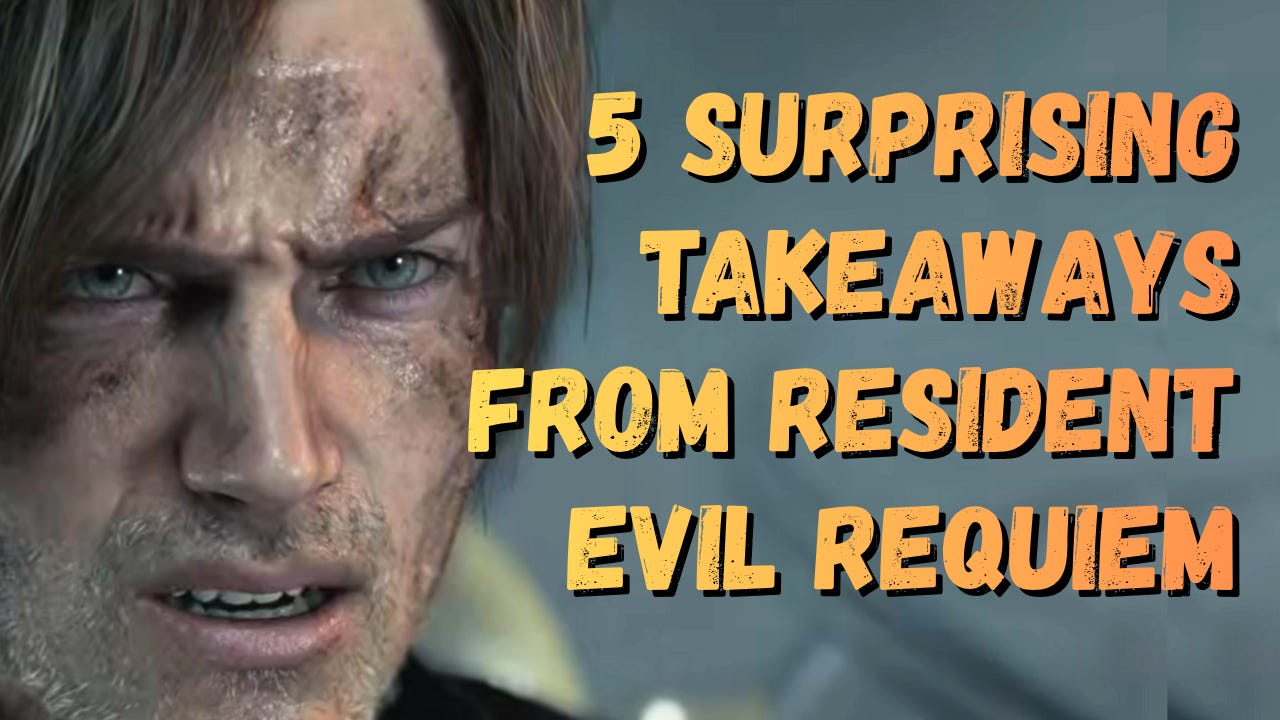
SPOILER ALERT: The following article contains major plot revelations, ending details, and character fates for Resident Evil 9: Requiem. Proceed only if you have finished the game or don't mind the secrets of Raccoon City being unearthed!
The trauma of Raccoon City is a scar on the Resident Evil universe that refuses to fade. While the modern era of the franchise often leans into a “clean,” clinical aesthetic—transitioning from the mold-infested bayous of Louisiana to high-tech European laboratories—the visceral decay of 1998 remains the series’ foundational ghost. Resident Evil 9: Requiem does not merely revisit this history; it interrogates the foundational sins of Oswell Spencer. Through the eyes of Grace Ashcraft, eight years after the brutal murder of her mother Alyssa, players are forced to confront the reality that some biological legacies are never truly buried.
Takeaway 1: The Molecular Ghost—Raccoon City Syndrome’s 30-Year Fuse
Perhaps the most chilling narratological shift in Requiem is the revelation that the nightmare of 1998 was never actually resolved for its survivors. The introduction of “Raccoon City Syndrome” recontextualizes the T-virus as a ticking time bomb. The game reveals a terrifying biological mechanic: residual T-virus particles have remained dormant within survivors for nearly thirty years.
For three decades, the bodies of heroes like Leon S. Kennedy and Sherry Birkin have been a battlefield where antibodies held the infection at bay. However, the virus has slowly gained immunity to those very antibodies, reactivating with lethal force in 2026. The symptoms—spreading black bruises and terminal hemoptysis (coughing blood)—provide a grim physical manifestation of a past that refuses to stay in the rearview mirror.
“Reports suggest that they only have about an hour or two left before they die. And so far all results have been fatal.”
Takeaway 2: The Elpis Subversion—Spencer’s Antiviral “Goddess of Hope”
For much of the campaign, the antagonists Dr. Victor Gideon and the Wesker-imitation, Zeno, hunt for “Elpis.” They operate under the delusion that it is a mind-control superweapon—the ultimate tool for biological supremacy. However, the game pulls a masterful subversion: Elpus is actually a “skeleton key” antiviral.
Named after the Greek goddess of hope, Elpis was Spencer’s secret attempt to atone for his “Pandora’s Box.” It was designed as a universal cure for the entire Progenitor-based family of viruses, including the T, G, C, T-Veronica, T-Phobos, and TG strains. This shift from god-complex villainy to terminal-stage remorse is captured on an MO disc containing Spencer’s own confession:
“His research opened up Pandora’s box and so every death is his fault... To make amends he took in a young girl.”
Takeaway 3: Grace Ashcraft—The Ordinary Girl vs. The Recombinant Legion
In a franchise increasingly populated by super-soldiers and mutated “Chosen Ones,” Grace Ashcraft represents a radical return to humanity. The villains believe Grace is a biological key, and they spent decades trying to replicate her through horrific experiments on hundreds of orphans. These victims, including Marie, Emily, and Khloe, were subjected to “recombinant DNA” manipulation in a futile effort to find “power” in Grace’s genetic makeup.
The tragic irony revealed in the Ark facility is that Grace is special precisely because she is un-mutated. She is a regular human whom Spencer raised at a distance—safeguarded by Alyssa Ashcraft—to ensure she remained untainted by his biological legacy. She was intended to be the one to release Elpis because her very lack of mutation made her the only viable candidate to trigger the cure.
Takeaway 4: The Shadow of the Pentagon—Political Decay in 2026
Requiem paints a bleak picture of a world where the line between the “good guys” and the bioterrorists has completely dissolved. By 2026, the US government has officially withdrawn from the Treaty of Prohibition on bio-organic weapons, sparking a new global arms race. This corruption has metastasized within the BSAA, specifically the North American branch, which is now revealed to be a puppet of the Pentagon and the shadowy syndicate known as “The Connections.”
This “New Umbrella” era is characterized by an obsession with the past. The presence of a “Hunk-like” commander and the deployment of the T-501 Tyrant model—a modern refinement of the original T-103 (Mr. X)—highlights a desperate attempt by rogue organizations to reclaim the biological “glory days.” Even Zeno himself is a ludological homage to Albert Wesker, acting as a hollow imitation of a man who once nearly broke the world.
Takeaway 5: Why It’s Called “Requiem”—A Meta-Tribute to the Classics
The title Requiem is more than just a somber name; it is a mourning ritual for the series’ roots. The narrative loop requires players to return to the ruins of Raccoon City, exploring locations like the Stagler gas station and the Kendo gun shop. Most poignantly, the return to the RPD feels like a visit to a tomb.
The STARS office remains as a haunting museum of the 1998 incident. Seeing Jill’s beret, Chris’s jacket, and Rebecca Chambers’ photo frozen in time serves as a powerful meta-tribute. By finally resolving the lingering T-virus infection and Spencer’s final secret, the game performs a literal requiem for the Umbrella era, allowing the legacy of 1998 to finally find a sense of closure.
Conclusion: A World Without Viruses?
The “Release Elpus” alternate ending offers a rare moment of genuine hope. With the deployment of the universal cure, Leon and Sherry are saved from the terminal stages of Raccoon City Syndrome. Even Emily, the victim of Gideon’s experiments, survives her mutation and regains her sight because Leon—acting on a veteran’s instinct—avoided shooting her in any vital areas during their confrontation.
But as the dust settles over the ruins of the Ark, a graver question remains. Spencer’s “Goddess of Hope” has rendered the world’s most dangerous bioweapons obsolete, yet The Connections remain active and the global political landscape is in shambles. If a universal cure now exists, does the threat of bio-terrorism truly end, or has the world simply entered a new, more chaotic era of anarchy where the rules of biological warfare have been permanently deleted?
― ZzennGame Reviews and Guides